




Extruder versus Pellet Mill: Which is Better for Livestock, Poultry, and Aquatic Feed Production?
In the feed manufacturing industry, especially for livestock, poultry, and aquaculture, two primary technologies are widely used for feed processing and shaping: extruder and pellet mill methods. Both machines play a vital role in improving production efficiency and enhancing product quality. However, their technical and functional differences make the choice dependent on the producer’s specific needs and production goals. In this article, we provide a complete comparison of these two technologies.
-
Introduction to Extruder
An extruder is a machine that processes raw materials under controlled pressure, heat, and moisture, forcing them through a die to produce feed with uniform size, shape, and texture. This method is highly effective in aquafeed production and certain specialty feeds for poultry and livestock.

Exteruder
Key Features of Extruder:
- Ensures full cooking of ingredients, improving digestibility
- Provides precise control over feed shape and texture
- Ideal for producing floating or sinking feeds for fish and shrimp.
- Flexible use of diverse raw materials
-
Introduction to Pellet Mills
A pellet mill, also known as a pellet press, compresses raw materials and forces them through die holes to produce dense, cylindrical pellets. It is mostly used in livestock and poultry feed production.
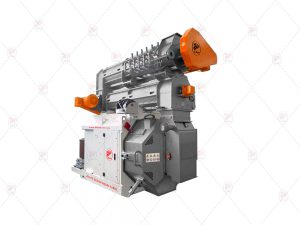
Pellet mill
- Produces highly dense feed with reduced volume
- Lower energy consumption compared to extruders
- Easier maintenance and simpler operation
- Suitable for ruminant and poultry feed
-
Differences in Production Process
Extruder:
- Raw materials are subjected to high pressure, heat, and moisture
- Mechanical shear and thermal effects gelatinize starches and denature proteins
- Feed expands slightly upon exiting the die due to pressure release
Capable of producing floating, semi-floating, or sinking aquafeeds
Pellet Mill:
- Ingredients are conditioned with medium steam and heat
- Pellets are formed by mechanical compression through the die
- Less physical and chemical modification compared to extrusion
- Produces mainly sinking feed, widely used for livestock and poultry
-
Feed Quality and Characteristics
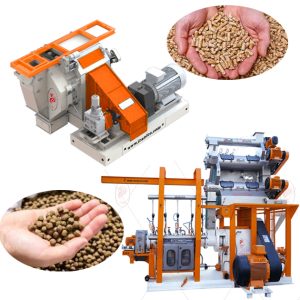 Extruder:
- Higher digestibility, particularly of starches
- Greater control over buoyancy and texture
- Handles high-fat or high-fiber formulations effectively
- Longer shelf life due to reduced microbial load
Pellet Mill:
- Produces denser, less porous pellets
- Better retention of heat-sensitive nutrients (e.g., vitamins).
- Consumes less energy than extrusion
-
Costs and Maintenance
Extruder
- Higher capital investment and energy consumption
- Provides superior product quality and process flexibility
- Operates like a “skilled chef,” fully cooking and shaping feed with added functional properties (e.g., floating feed).
Pellet Mill:
- Lower purchase cost, reduced energy use, and simpler maintenance
- Higher throughput in large-scale production
- Functions more like a feed compressor, shaping feed without significant thermal changes
-
Final Product Differences
Extruder:
- Produces lighter, uniform, highly digestible feed. Floating and sinking feeds are possible, making it ideal for aquaculture.
Pellet Mill:
- Produces denser, heavier pellets with longer storage stability but generally less digestible
-
Applications
Extruder:
- Aquafeed (fish and shrimp), specialty poultry diets, pet food, and certain industrial products
Pellet Mill:
- Livestock and poultry feed where high density and bulk production are required
| Feature | Extruder | Pellet Mill |
| Process Type | Cooking, pressure, shear, expansion | Mechanical compression + steam conditioning |
| Operating Temperature | High (90–180 °C) | Medium (60–90 °C) |
| Operating Pressure | High (30–40 bar) | Medium (5–10 bar) |
| Thermal Effect | Strong – full starch gelatinization, protein denaturation | Mild – limited chemical changes |
| Product Form | Floating, semi-floating, sinking, expanded | Dense, sinking pellets |
| Feed Texture | Porous, light, or semi-dense | Compact and heavy |
| Digestibility | High (due to complete cooking) | Medium |
| Common Application | Aquafeed, pet food, specialty poultry & livestock | Poultry, ruminants, some aquafeed |
| Energy Consumption | High | Lower |
| Initial Investment | Higher | Lower |
| Main Advantage | Full control of quality & physical properties | High capacity, lower cost |
| Main Limitation | High energy and capital costs | Limited flexibility in product diversity |
Extruder or Pellet Mill: Which is Better?
The choice between an extruder and a pellet mill depends on your product type, market requirements, and budget. If digestibility, feed quality, and product versatility are priorities, the extruder is the superior option. If cost efficiency, simplicity, and large-scale production are more important, the pellet mill is the better choice.
👉 For professional consultation and to select the most suitable extruder or pellet mill for your feed mill, contact Atiye Sazan Negin Faraz today.
FAQs: Extruder versus Pellet Mill in Feed Production
-
Which method produces higher-quality feed?
Extrusion, as it ensures complete cooking, reduces microbial load, and allows control over buoyancy—especially important for aquafeed.
-
What are the advantages of pellet mills?
Pellet mills are ideal for high-volume, cost-efficient production. They produce dense and durable pellets for livestock and poultry.
-
Is an extruder always better than a pellet mill?
No. The choice depends on feed type, market demand, and budget. Extruders offer flexibility, while pellet mills are more economical.
-
How do production costs differ?
Extruders require higher investment and energy costs but deliver superior quality. Pellet mills are cheaper and faster to operate.
-
Which technology is recommended for aquafeed?
Extrusion technology, because it can produce floating, semi-floating, and sinking feeds with high durability—ideal for fish and shrimp farming.
Looking for the best machine to optimize your feed production line?
The engineering team at Atiye Sazan Negin Faraz is ready to provide you with free professional consultation for choosing between an extruder or a pellet mill tailored to your specific production needs.
✅ Free expert consultation (Click on Contact us form, and L.lion experts contact you as soon as possible)
✅ Detailed catalog and technical specifications
✅ Full support in equipment selection and purchase
📞+989120275171
📧 info[at]iranlco.com


1 Comment