
What is flaking and how is flake feed produced?
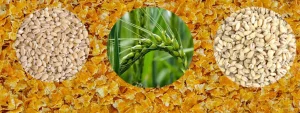
Flaking technology has transformed grains and legumes into one of the most valuable sources of nutrients in livestock nutrition.
One of the key advantages of this technology is its ability to achieve higher feed efficiency compared with many other feed-processing methods, without requiring the addition of any feed additives to the processed grains and legumes. Through this process, maximum digestibility of the product within the animal’s digestive system is achieved.
Since flaked products undergo a cooking process, the starch contained in the grains becomes gelatinized, significantly improving its digestibility. In addition, the flattened flake structure increases the surface area exposed to digestive enzymes in the animal’s stomach, further enhancing nutrient utilization.
The use of valuable raw materials such as starch-rich grains and protein-rich legumes, together with the desirable flavor developed during processing, improved palatability, and enhanced digestibility, encourages greater feed intake by livestock. As a result, the animal’s genetic potential for growth and production can be fully expressed without imposing excessive stress on its metabolic system.
Consequently, compared with the same quantity of conventional mash feed, flaked feed can lead to higher meat production, increased milk yield, and improved growth performance.
Although grain cooking can also be achieved using an Expander, flaking remains one of the most economical technologies for thermal processing of grains. Therefore, whenever the objective is to produce cooked feed, flaking technology should be carefully considered.
While this technology is relatively new in some countries, it has been widely adopted throughout the United States and Europe.
How Is Flaked Feed Produced?
- Main Stages of Flaked Feed Production
- Raw material quality control
- Product cleaning
- Cooking
- Flaking
- Drying and cooling
- Packaging
Raw Material Quality Control
Grains intended for processing must be evaluated for:
- Moisture content
- Impurity level
- Starch content
- Protein content
- Fat content
- Aflatoxin contamination
Raw materials that do not meet the established quality standards should not enter the production process.
Product Cleaning
Using powerful aspiration systems and advanced screening equipment, grains must be thoroughly cleaned to remove impurities such as:
- Broken kernels
- Stones
- Dust
- Soil
- Foreign materials
- Stalks
- Plant residues
Incoming raw materials may contain up to 10% impurities. Particular attention should be given to broken kernels, as they are among the primary factors contributing to quality deterioration and spoilage during storage.
Cooking
The product is cooked using high-pressure dry steam for a minimum of one hour.
Key principles of this stage include:
- Steam must be completely dry.
- Water used for steam generation should meet potable water quality standards.
During cooking, harmful microorganisms are eliminated, while the combination of high temperature and extended retention time promotes starch gelatinization.
Major benefits of the cooking stage include:
- Improved digestibility
- Product sterilization
- Enhanced feed efficiency
- Better livestock performance
Flaking
Both undercooking and overcooking can significantly affect the final quality of flaked feed. After cooking, the product passes through heavy-duty flaking rolls where it is subjected to very high pressure in order to:
- Expand its internal structure
- Increase exposure to digestive enzymes
- Maximize nutrient availability for livestock
Proper flaking is just as important as proper cooking. The thickness of the product is typically reduced to approximately 0.8–1.5 mm, producing a uniformly flaked product.
Drying and Cooling
Following cooking and flaking, the product enters a dryer and subsequently a cooler to reduce its moisture content and temperature.
Care must be taken during drying to avoid damaging the gelatinized starch structure.
If drying and cooling are not properly performed, the product may undergo fermentation, potentially leading to:
- Bloating
- Digestive disorders
- Other undesirable health issues in livestock
Packaging
After drying and cooling, the finished product may be supplied in one of the following forms:
- Bulk
- Big Bags
- Bagged packaging
Benefits of Flaked Feed for Livestock
Reduced feed costs and improved feed efficiency are among the benefits of the flaked feed. The cooking and flaking processes increase the feed’s surface area while reducing particle thickness. This enhances starch gelatinization and allows digestive enzymes to access nutrients more effectively.
As a result, animals are able to realize their full genetic potential for growth and production. With the same feed intake, greater meat production or milk yield can be achieved compared with many conventional feed types.
Feed Sterilization
During the flaking process, product temperatures may reach approximately 130°C. The combination of elevated temperatures and prolonged cooking time destroys harmful microorganisms and bacteria, resulting in a highly sanitized feed product.
Improved Digestive Health
Livestock producers often use sodium bicarbonate and dietary buffers to reduce ruminal acidity, which increases feed costs.
Because starch in flaked feed is properly processed and more digestible, it is less likely to contribute to excessive acidity in the digestive tract. Consequently, the need for costly buffering additives may be reduced.
Regular use of flaked feed may also help decrease the incidence of laminitis, a common lameness disorder associated with metabolic disturbances.
Increased Feed Intake
Flaked feed generally offers superior aroma, flavor, and palatability, encouraging animals to consume more feed.
This can result in:
- Increased feed intake
- Faster growth rates
- Higher meat production
- Greater milk yield
Flaking technology fully aligns with the principle of achieving greater production at lower cost, which remains the primary objective of livestock production enterprises. Although this technology has not yet reached its full development potential in some countries, it is rapidly expanding throughout many advanced agricultural markets and has secured a prominent position within the global animal feed industry.
for more information,please contact us: