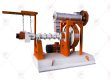

Aquafeed Extruder Die| 210, 260 & 320 mm Die Design and Manufacturing
The extruder die is one of the key components of an aquafeed extruder. Located at the end of the extrusion chamber, the die creates resistance to material flow and plays an important role in product forming, process pressure generation, and controlling the discharge conditions of the feed from the extruder. After passing through the conveying, mixing, heating, and cooking stages, the material is forced through the die openings under pressure. The sudden pressure drop at the die outlet causes part of the water contained in the material to vaporize, which can result in product expansion and a reduction in bulk density.
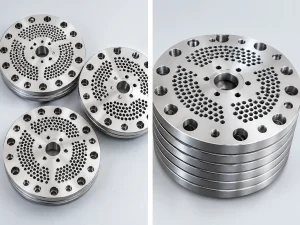
Therefore, the die is not simply a component used to determine product shape; it is an integral part of the extrusion process. Die geometry, hole diameter and number, hole arrangement, and flow resistance, together with parameters such as feed formulation, moisture content, processing temperature, screw speed, feed rate, and preconditioning conditions, affect the characteristics of extruded aquafeed. Research on aquafeed extrusion has also demonstrated the effects of die-hole diameter and process conditions on product expansion, bulk density, buoyancy, durability, and water stability.
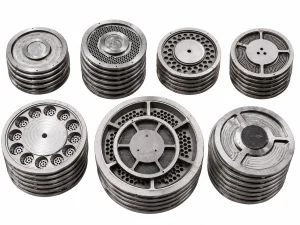
Aquafeed Extruder Dies
Aquafeed extruder dies are designed and manufactured according to the extruder model and dimensions, production capacity, target product specifications, and process conditions. The dies manufactured in this range are available with outer diameters of 210, 260, and 320 mm.
The outer diameter of the die is a structural and geometric specification and should not be confused with the die-hole diameter or the final pellet diameter. The hole diameter, number of holes, and hole arrangement are selected according to the target product and operating conditions.
| Specification | 210 mm Die | 260 mm Die | 320 mm Die |
|---|---|---|---|
| Outer die diameter | 210 mm | 260 mm | 320 mm |
| Available hole diameters | 3, 5, and 8 mm | 3, 5, and 8 mm | 3, 5, and 8 mm |
| Number of holes | According to engineering design | According to engineering design | According to engineering design |
| Hole arrangement | According to process and mechanical requirements | According to process and mechanical requirements | According to process and mechanical requirements |
| Application | Aquafeed extrusion | Aquafeed extrusion | Aquafeed extrusion |
| Final pellet diameter | Depends on hole diameter and die expansion | Depends on hole diameter and die expansion | Depends on hole diameter and die expansion |
Parameters Affecting Die Design
Die design should be carried out from both extrusion-process and mechanical-engineering perspectives. Increasing the number of holes can increase the available open area for material flow; however, the spacing between holes, die thickness, and remaining cross-sectional area must also be considered to maintain sufficient mechanical strength and manufacturability.
The number and diameter of die holes also affect flow resistance and the pressure required for material discharge. Therefore, the die geometry must be selected according to the formulation, product specifications, desired production capacity, and operating conditions.
| Design Parameter | Importance in Die Design and Performance |
|---|---|
| Outer die diameter | Determines the overall dimensions of the die and the available area for hole arrangement |
| Hole diameter | Affects initial extrudate diameter, flow resistance, and product expansion |
| Number of holes | Affects the open flow area and potential material throughput |
| Hole arrangement | Affects flow distribution and mechanical strength |
| Hole spacing | Determines the remaining cross-sectional area and contributes to mechanical strength |
| Die thickness / hole length | Affects flow resistance and process pressure |
| Hole inlet geometry | Affects material entry and flow distribution |
| Hole surface condition | Affects friction, wear, and flow uniformity |
| Material and heat treatment | Affect strength, wear resistance, and service life |
| Machining tolerances | Affect hole uniformity and stable product discharge |
Effect of the Die on Aquafeed Quality
Die-hole diameter is one of the parameters affecting pellet diameter and product expansion. However, the final pellet diameter is not necessarily equal to the die-hole diameter because the extrudate may expand after leaving the die. The degree of expansion depends on the formulation and extrusion-process conditions.
Therefore, the die should be selected according to the desired characteristics of the final product:
| Desired Feed Characteristic | Relevant Die and Process Factors |
|---|---|
| Pellet diameter | Die-hole diameter and degree of expansion |
| Buoyancy | Final density and degree of expansion, together with formulation and process conditions |
| Bulk density | Pressure, temperature, moisture, formulation, and die geometry |
| Production capacity | Number and diameter of holes, open die area, feed rate, and screw speed |
| Pellet uniformity | Hole uniformity, flow distribution, and process stability |
| Pellet durability | Formulation, cooking degree, moisture, and expansion conditions |
| Water stability | Formulation, cooking degree, pellet structure, and density |
Die Hole Diameter and Pellet Size
The available die-hole diameters are 3, 5, and 8 mm. These hole sizes can be selected according to the target pellet size and the requirements of the aquafeed product.
| Die Hole Diameter | Typical Application |
|---|---|
| 3 mm | Suitable for smaller-diameter aquafeed pellets and applications requiring finer feed particles |
| 5 mm | Suitable for medium-diameter pellets and a wide range of aquafeed applications |
| 8 mm | Suitable for larger-diameter pellets and feed products intended for larger fish and aquatic animals |
Important: A 3, 5, or 8 mm die hole does not necessarily produce a final pellet with exactly the same diameter. The final pellet size depends on the degree of die expansion and the extrusion conditions.
Mechanical Design and Manufacturing of the Die
In addition to its process function, an extruder die must be mechanically designed to withstand operating conditions. The design should consider process pressure, die thickness, number and arrangement of holes, spacing between holes, material properties, heat treatment, and wear conditions.
If the number of holes is increased excessively, the remaining material between the holes may be reduced, potentially affecting the mechanical strength of the die. Conversely, an excessively low number of holes can reduce the open flow area and increase flow resistance and process pressure.
Therefore, die design requires an engineering balance between material throughput, process conditions, product quality, mechanical strength, and manufacturability.
Precision machining is also critical. Hole diameter, hole position, spacing, surface finish, and geometric uniformity should be controlled within the specified tolerances to promote uniform material flow through the individual die holes.
Selecting the Appropriate Die for the Product
The appropriate die should be selected based on a combination of parameters rather than solely on the outer die diameter or number of holes. Aquatic species, feed type, target pellet diameter and density, desired buoyancy, production capacity, formulation, feed moisture, preconditioning conditions, and extruder operating parameters should all be considered.
The following die configurations are available:
| Outer Die Diameter | Available Hole Diameters | Application |
|---|---|---|
| 210 mm | 3, 5, and 8 mm | Aquafeed extrusion |
| 260 mm | 3, 5, and 8 mm | Aquafeed extrusion |
| 320 mm | 3, 5, and 8 mm | Aquafeed extrusion |
The number and arrangement of holes are determined according to the required production capacity, product specifications, extrusion conditions, and mechanical design requirements.
Conclusion
The aquafeed extruder die is a mechanical and process-critical component that contributes to product forming, flow resistance, outlet pressure, expansion, and the achievement of the desired feed characteristics.
Dies with outer diameters of 210, 260, and 320 mm can be designed and manufactured with 3, 5, and 8 mm hole diameters, depending on the extruder model and production requirements. The number and arrangement of holes should not be determined solely by the outer die diameter. Instead, they should be designed by considering hole diameter, open area, hole spacing, die thickness and mechanical strength, required production capacity, and extrusion-process conditions.
Optimal die performance is achieved when the die design is properly matched with the feed formulation, extrusion conditions, and mechanical characteristics of the extruder.
For more information, please contact us.