
Magnetic Tube for Ferrous Metal Removal in Animal Feed, Poultry Feed, and Aquafeed Production Lines
The Magnetic Tube is a simple, effective, and cost-efficient piece of equipment designed to remove ferrous metal particles and fragments from material streams in animal feed, poultry feed, and aquafeed production facilities. Using permanent magnets, the unit attracts ferromagnetic contaminants present in raw materials or finished products, helping prevent them from reaching sensitive equipment and subsequent stages of the production process.
Metal contaminants such as iron filings, wires, screws, nuts, worn metal fragments, and other ferrous objects may enter the raw material stream and cause damage to processing and rotating equipment, increase mechanical wear, result in unplanned production downtime, and ultimately lead to metal contamination of the final product. For this reason, magnetic separation is widely used as a protective measure in feed processing lines.
Applications of the Magnetic Tube in Feed Mills
L.lion Magnetic Tube is designed for installation at various points throughout animal feed, poultry feed, and aquafeed production lines. Depending on the layout and process requirements of the line, the unit can be installed directly in the material flow path.
Typical installation points include:
- Upstream of the Rotary Distributor
- Upstream of the Hammer Mill
- Upstream of the Homogenizer
- Upstream of the Pellet Mill
- Upstream of screening and cleaning equipment
- Other locations where ferrous particles may enter or be generated within the material stream
Installing a magnetic separator upstream of critical equipment such as hammer mills and pellet mills can provide an additional protective barrier and help reduce the risk of ferrous objects reaching sensitive mechanical components.
Magnetic Tube Design and Construction
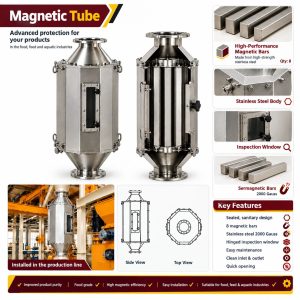
The Magnetic Tube manufactured by our company features an octagonal housing. This geometry is designed to provide a suitable material flow path while allowing effective positioning of the magnetic assembly within the product stream.
The main design features include:
Octagonal Housing
The octagonal configuration provides a suitable geometry for positioning the unit within the material flow and promotes effective exposure of the product stream to the magnetic surfaces.
Inspection Door
The Magnetic Tube is equipped with an inspection door, providing convenient access for internal inspection, checking the condition of the magnetic assembly, cleaning, and removing accumulated metal particles.
Robust Metal Construction
Depending on operating conditions and project requirements, the housing can be manufactured from carbon steel or stainless steel. The internal components are made of stainless steel, making them suitable for industrial environments and contact with the material stream.
Permanent Magnets
The magnetic assembly consists of eight ceramic magnets with a nominal magnetic field strength of 2,000 gauss.
Operating Principle
As the material passes through the Magnetic Tube, it enters the effective range of the magnetic field. When iron particles and other ferromagnetic contaminants come within the magne tic field, the resulting magnetic force attracts them toward the magnetic surfaces.
The captured metal particles are retained on the magnetic assembly until inspection and cleaning are carried out.
From an engineering perspective, separator performance does not depend solely on the nominal magnetic field strength. Factors such as the distance between the metal particle and the magnetic surface, material bed thickness, flow velocity, material distribution, particle size and shape, and product flow characteristics can also significantly affect separation performance.
Therefore, selecting the appropriate installation location and designing a suitable material flow path are important factors in achieving effective Magnetic Tube performance.
Key Advantages of the Magnetic Tube
- Removal of ferrous particles and metal fragments from the material stream
- Protection of downstream equipment against the entry of metal objects
- Helping reduce the risk of damage and excessive wear to processing equipment
- Suitable for animal feed, poultry feed, and aquafeed production lines
- Use of permanent magnets with no electrical power required to generate the magnetic field
- Simple and reliable mechanical design
- Easy access for inspection and cleaning through the inspection door
- Housing available in carbon steel or stainless steel, depending on project requirements
- Octagonal design suitable for installation within material conveying systems
Why Is a Magnetic Tube Important in Feed Production?
In feed production lines, metal contaminants can originate from various sources, including raw materials, conveying equipment, mechanical wear, maintenance and repair activities, or contamination already present in incoming materials.
The presence of metal fragments can pose a risk to processing equipment and may lead to equipment damage, increased wear, unplanned downtime, and product contamination. Magnetic separation systems are therefore commonly used at strategic locations in feed processing lines, including material inlets, upstream of grinding equipment, and along routes leading to pelletizing equipment.
The Magnetic Tube can consequently be considered a mechanical and process protection layer at critical points of a production line. With a simple mechanical structure and permanent magnets, it provides a practical means of removing ferrous contaminants without requiring electrical power to generate the magnetic field.
Technical Specifications
| Specification | Description |
|---|---|
| Equipment Name | Magnetic Tube |
| Application | Removal of ferrous metal particles and fragments |
| Target Industries | Animal Feed, Poultry Feed, and Aquafeed |
| Housing Shape | Octagonal |
| Number of Magnets | 8 |
| Magnet Type | Ceramic |
| Nominal Magnetic Field Strength | 2,000 gauss |
| Housing Material | Carbon Steel or Stainless Steel |
| Internal Component Material | Stainless Steel |
| Inspection Door | Provided |
| Power Requirement for Magnetic Field Generation | None |
| Typical Installation Points | Upstream of Rotary Distributor, Hammer Mill, Homogenizer, Pellet Mill, Screening/Cleaning Equipment, and other suitable points in the production line |
Engineering Note
The 2,000-gauss value represents the nominal magnetic field strength of the magnets and should not, by itself, be considered an indicator of the overall separation efficiency of the equipment.
Actual Magnetic Tube performance depends on several operating and design parameters, including installation conditions, distance between the material and magnetic surface, material characteristics, throughput, and the size and properties of the metal particles.
Therefore, the dimensions and magnetic assembly configuration of the Magnetic Tube should be selected according to the actual capacity, process conditions, and requirements of the production line.
For more information, please contact us.