




Laser and Plasma Cutting Services at Atiye Sazan Negin Faraz Knowledge-Based Company
Selecting the appropriate metal-cutting method is not merely a simple technical decision; it can significantly affect the quality, schedule, and overall cost of a project. But what are the differences between laser and plasma cutting, and under what conditions does each method perform best?
To select the most suitable method for a specific project, the priorities must first be clearly defined. In projects where high precision, fine details, and clean, burr-free edges are critical, laser cutting is generally the preferred option. This technology delivers highly accurate and high-quality results for complex designs, particularly when cutting thin to medium-thickness sheets.
By contrast, when production volume is high and time constraints are significant, while precision is a secondary priority, plasma cutting may be the more suitable choice. Its high cutting speed and ability to penetrate thick metals make plasma cutting well suited to industrial projects with tight schedules and limited budgets.
What Is Laser Cutting?
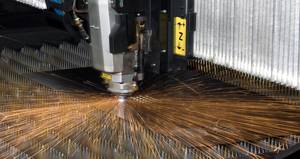
Laser cutting is one of the most advanced cutting technologies used in modern industries for shaping or separating a wide range of materials. In this process, a concentrated, high-energy laser beam is directed onto the surface of the workpiece. The resulting localized heat melts, vaporizes, or otherwise removes the material to create the desired cut. This process produces smooth, precise edges with minimal distortion.
Laser cutting machines use a laser source, such as a CO₂ or fiber laser, to generate a high-energy beam. The beam is directed through a system of specialized optics and focused onto an extremely small area of the workpiece. The intense concentration of energy at this point causes a rapid increase in temperature, ultimately melting or vaporizing the material at the desired location.
Laser cutting can be used to produce complex and intricate patterns in a variety of materials, including metals, wood, plastics, textiles, and other materials. The high precision and controllability of the laser cutting process have led to its widespread application in industries such as automotive manufacturing, appliance manufacturing, advertising, interior design, and even artistic applications.
Advantages of Laser Cutting
- High cutting speed
- High precision
- Reduced material waste
Selecting an appropriate sheet thickness and correctly adjusting the machine parameters are important factors in maintaining the final cutting quality.
Plasma Cutting Technology: A Combination of Power and Speed
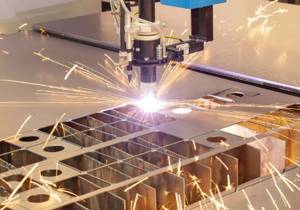
Plasma cutting uses a gas ionization process. In this method, an electric current passes through a high-velocity gas stream and transforms it into a plasma arc. The high-energy plasma arc acts like an extremely hot cutting tool capable of rapidly penetrating and cutting hard metals.
The concentrated thermal energy generated during plasma cutting enables the process to cut relatively thick workpieces. The simplicity of operation and high production speed have made plasma cutting a widely used method in industries such as construction, automotive manufacturing, and heavy-duty repair, where speed and cost-effectiveness are major priorities.
Plasma cutting generally produces relatively smooth cut edges. This demonstrates the ability of the electrical arc to rapidly melt and separate metal. Overall, plasma provides an effective solution for projects requiring high cutting speed and substantial cutting capacity, with less emphasis on extremely fine details.
What Are the Differences Between Laser and Plasma Cutting?
Laser and plasma cutting differ in several key aspects, including:
- Energy source
- Operating mechanism
- Cutting mechanism
- Precision and detail
- Cuttable materials
- Dimensional accuracy
Difference in Energy Source
One of the primary factors distinguishing the capabilities, applications, and performance of laser and plasma cutting is their different energy sources. The different mechanisms used to generate and transfer energy give each technology its own range of applications. In general, the project requirement for high dimensional precision favors laser cutting, while the need for high cutting power and the ability to process greater material thicknesses favors plasma cutting. These differences in energy generation and delivery fundamentally define the technical characteristics of each method.
Energy Source in Laser Cutting
In laser cutting technology, the energy required for the process is supplied by a concentrated, high-power beam of light. The machine is designed to direct this narrow beam through a system of precision optics and focus it onto an extremely small area of the workpiece. The intense concentration of optical energy causes a rapid increase in temperature at that point, bringing the material to its melting point or, in some cases, causing vaporization.
As a result, material separation occurs precisely at the point where the laser beam interacts with the workpiece, producing a cut with high dimensional accuracy. The process energy is supplied and controlled through this focused optical source, and because there is no direct mechanical contact between the cutting tool and the workpiece, high edge quality can be achieved.
This characteristic makes laser cutting particularly suitable for producing fine lines, complex geometries, and highly uniform edges across a wide range of industrial applications.
Energy Source in Plasma Cutting
In plasma cutting, energy is generated through the interaction of an electrical current and a compressed gas. In the system, a gas such as air, nitrogen, or another industrial gas is forced through a nozzle under pressure. At the same time, a strong electrical current passes through the gas and ionizes it. This process generates a plasma arc—a very hot, high-energy, electrically conductive stream capable of rapidly melting metal.
The concentrated heat of the arc raises the material at the cutting point to its melting temperature within a very short period, while the high-velocity gas stream removes the molten material from the cut zone. Therefore, unlike laser cutting, the required energy is generated through the interaction of electricity and gas rather than a focused light beam.
For this reason, plasma cutting is particularly common in industrial workshops and projects where high cutting speed and the ability to process relatively thick metal sections are important.
Difference Between Laser and Plasma Cutting in Terms of Operating Mechanism
The difference between these two methods is not limited to their energy sources; the way each technology interacts with the material is also fundamentally different. The method of energy transfer, heat generation, and material removal determines the resulting edge quality, dimensional accuracy, cutting speed, and, to a certain extent, the types of materials that can be processed.
In practical terms, choosing between laser and plasma cutting means selecting a specific approach for processing the workpiece. Each method has its own advantages and limitations, and depending on the project requirements, one may be more suitable than the other.
Cutting Mechanism in Laser Technology
In laser cutting, material separation is achieved by concentrating a high-intensity optical beam onto an extremely small area. The laser beam heats the surface of the workpiece to its melting or vaporization threshold, and the process is performed without direct mechanical cutting forces.
The entire operation is controlled by computer-based systems, enabling high dimensional accuracy and smooth cut edges. Because there is no direct mechanical contact between the cutting tool and the workpiece, mechanical stresses are minimal, resulting in a clean cut with accurately defined details.
Cutting Mechanism in Plasma Technology
In a plasma cutting system, the cutting tool is a torch connected to an electrical power source and a gas supply. When the torch is brought close to the workpiece, an electrical potential difference creates an arc between the electrode and the metal surface. This arc ionizes the gas passing through the torch and converts it into plasma, an extremely hot and electrically conductive state of matter.
The high temperature of the plasma melts the metal locally, while the gas stream simultaneously removes the molten material from the cut zone. The result is a rapid and effective cutting path through the metal.
The relatively simple operating principle, high cutting speed, and ability to process thick workpieces are among the main reasons for the widespread use of plasma cutting in heavy industries and construction projects.
Difference Between Laser and Plasma Cutting in Terms of Precision and Detail
When the final quality of a component and the accurate execution of design details are critical, cutting precision and detail become decisive factors in metal fabrication. Precision refers to the ability of the cutting system to reproduce the specified dimensions and contours with minimal deviation. Detail refers to the quality of the cut edges, surface uniformity, and accurate reproduction of small features.
In this regard, laser technology provides a high level of precision. The highly concentrated optical energy allows the production of clean cutting lines, sharp corners, and complex geometries. Even designs with fine curves or very small details that may be difficult to produce using conventional mechanical tools can be accurately processed using laser cutting.
For this reason, laser cutting is generally preferred in projects where edge quality and dimensional accuracy are the primary requirements.
Plasma cutting, by comparison, places greater emphasis on cutting speed and the ability to process thicker materials. Although plasma cutting can also provide acceptable dimensional accuracy, its cut edges may be somewhat rougher than those produced by laser cutting, and it may have limitations when processing very fine details.
Therefore, when the objective is to produce heavy components at high speed, plasma cutting can be an appropriate solution, whereas laser cutting generally provides better performance for intricate and precision-oriented work.
Ultimately, the choice between these two technologies largely depends on the project’s sensitivity to dimensional accuracy, fine details, and edge quality.
Difference Between Laser and Plasma Cutting in Terms of Cuttable Materials
Another important difference between the two methods is the range of materials they can process. Laser cutting offers considerable versatility and, depending on the laser source and process configuration, can be used to cut various metals as well as certain non-metallic materials.
Plasma cutting, on the other hand, is primarily designed for electrically conductive materials, including steel, stainless steel, aluminum, copper, and other conductive metals.
In simple terms, if a project involves a variety of material types, laser cutting can offer greater flexibility. If the application is focused exclusively on electrically conductive metals, plasma cutting can effectively meet the requirements.
Comparison of Laser and Plasma Cutting Speed
In terms of cutting speed, both technologies can provide high productivity, but the specific application determines which method is more efficient.
Laser cutting can maintain high cutting speeds even when processing complex designs with numerous details. This characteristic has made laser technology particularly popular for precision components and industrial production applications.
Plasma cutting also provides very high cutting speeds, particularly when processing thick sheets and relatively simple geometries. It is highly productive for high-volume manufacturing and heavy industrial projects where design complexity is lower.
Overall, laser cutting can combine speed and quality in complex designs, whereas plasma cutting performs particularly well in high-speed cutting of thicker and relatively simple components.
Comparison of Cutting Thickness
In terms of cutting capacity for thicker materials, plasma cutting generally has an advantage. Depending on the equipment and process parameters, plasma systems can cut metals with thicknesses of approximately 50 mm. In comparison, the typical cutting range of laser systems for common metals may extend to approximately 25 mm, although high-power laser systems can, depending on the material and process conditions, reach approximately 30–35 mm.
Therefore, for projects involving very thick metal sections, plasma cutting may be a more suitable option, while laser cutting generally provides higher precision and edge quality for thin and medium-thickness materials.
Comparison of Dimensional Accuracy
In terms of dimensional accuracy, laser cutting can typically achieve tolerances in the range of approximately 0.05 mm, making it a highly precise cutting method. Plasma cutting, by comparison, typically achieves dimensional accuracy in the range of approximately 0.3–0.5 mm, depending on the equipment, material, thickness, and cutting parameters.
This difference indicates that for projects requiring high dimensional accuracy and fine detail, laser cutting is generally the more appropriate choice, whereas plasma cutting can effectively meet the requirements of heavy industrial applications where dimensional tolerances are less stringent.
For consultation and further information, please contact us.